I plan to write up the shiur I heard today from Rav Ti about Ruth, but with my laptop broken I wasn't able to take notes, and it may take some time. Meanwhile, its just intresting that for all the complaints people make about having to learn Tanakh in Hebrew, it actually helps to know English. Transilations by thier very nature will be impercise, but in the Tanakh it makes a big diffrence because the language is meant to be very very percise. Normally that means that when you try to transilate the Tanakh you have two problems (well there are many more, but these ones are relevant to what I am saying).
1) It is difficult or impossible to fight the equivlent word in English (or whatever language you are transilating into)
2) Since most words don't have an exact 1-to-1 correspondance from Hebrew to English, your word choice is by definition an interpretation.
So after all that introduction, what is my point?
רות א:5 Ruth 1:5
וַיָּמֻתוּ גַם-שְׁנֵיהֶם, מַחְלוֹן וְכִלְיוֹן; וַתִּשָּׁאֵר, הָאִשָּׁה, מִשְּׁנֵי יְלָדֶיהָ, וּמֵאִישָׁהּ.
And Mahlon and Chilion both died, and the woman (Naomi) Va'tishaer from/of her two children and of her husband.
So what belongs in place of Va'tishaer ?
Well Rav Ti asked the full room: "מה התגום של ותשאר...הרתגום לאנגלית?" (What is the translation of Va'Tishaer, the translation into English)
So people threw out ideas: survived, left, stayed, remained
The point was that it was pretty obvious that if her husband and children died, then she was survived by them, so what is this verse adding?
In context if you use the word stayed or remained then you develop a picture that Naomi is staying in the Galut outside of Eretz Yisrael. This is why English helps you understand Tanakh
This is a good time to mention that "A Jew is Israel has G-d, a Jew outside of Israel has no G-d." Not "is like he has no G-d." There is a reason that it was especially true in biblical times, but here is not the place to expand on it.
An interesting post on translating and Torah can be found here
Showing posts with label Torah. Show all posts
Showing posts with label Torah. Show all posts
Monday, May 14, 2007

Sunday, March 18, 2007
learning moed katan
With the starting of tractate Moed Katan, R' Chaim Kanievsky said that it is known in the name of the Chasam Sofer that there is a concern in learning Moed Katan because of the fact they you are learning the halachos of mourning. Therefore the Chasam Sofer said that a person should give charity before learning this tractate.- published in the Yated Neman via Jewish Worker
R' Kanievsky added that certainly someone who gives charity to "Kupat Hair" will be saved from any pain and anguish and has nothing to worry about.
As always, the names of all donors will be passed on to R' Kanievsky for a blessing
Its a good thing I don't believe in the superstition and also follow Rabbis who think learning Moed Katan is important.
And to quote the Rav when people asked used to ask him for a bracha (blessing) :
What are you an apple?Also it is shameless to say donate to my charity and no harm will come to you. Now if that only worked.
Math while listening to the parsha
While I was listening to the Torah reading I did some quick math in my head twice
The first instance was when the Torah was going over the donations, I was wondering how much is a ככר(kikar, talent) of precious metal? So first I thought, well maybe
So first I thought: maybe its 1000 shekel. its more than 730. But then:
Anyway the math
603,550 people (men over 20 of the nation of Israel) give 0.5 shekel which makes 301,775 shekel. Subtract 1775 for the left overs and you are left with 300,000 shekel being equal to 100 talents, meaning one talent was 3,000 shekel. Hmm before I calculated it during the reading I thought it would be 2,000 shekel, I wonder why I thought that?
Then later we have the Golden Altar for the sacrifices of animals, I always think of it as very big and impressive, tall and imposing. Well, it couldn't be that big, it would have to be carried whole.
An אמה(bredth) is normally 5 tefachim(handbreadth) but for the משכ ן(tabernacle) it is 6. A handbreadth is taken to be between 8-10cm. So it is between
3 x 6 x 8cm = 1.44 meters (4'8") and 3 x 6 x 10 cm= 1.8 meters (5'11")
I guess I already knew that, but I just usually thought of it as bigger in my mind. Well if you didn't know, now you do
The first instance was when the Torah was going over the donations, I was wondering how much is a ככר(kikar, talent) of precious metal? So first I thought, well maybe
| כד כָּל-הַזָּהָב, הֶעָשׂוּי לַמְּלָאכָה, בְּכֹל, מְלֶאכֶת הַקֹּדֶשׁ--וַיְהִי זְהַב הַתְּנוּפָה, תֵּשַׁע וְעֶשְׂרִים כִּכָּר, וּשְׁבַע מֵאוֹת וּשְׁלֹשִׁים שֶׁקֶל, בְּשֶׁקֶל הַקֹּדֶשׁ. | 24 All the gold that was used for the work in all the work of the sanctuary, even the gold of the offering, was twenty and nine talents, and seven hundred and thirty shekels, after the shekel of the sanctuary. |
So first I thought: maybe its 1000 shekel. its more than 730. But then:
Anyway the math
603,550 people (men over 20 of the nation of Israel) give 0.5 shekel which makes 301,775 shekel. Subtract 1775 for the left overs and you are left with 300,000 shekel being equal to 100 talents, meaning one talent was 3,000 shekel. Hmm before I calculated it during the reading I thought it would be 2,000 shekel, I wonder why I thought that?
Then later we have the Golden Altar for the sacrifices of animals, I always think of it as very big and impressive, tall and imposing. Well, it couldn't be that big, it would have to be carried whole.
| א וַיַּעַשׂ אֶת-מִזְבַּח הָעֹלָה, עֲצֵי שִׁטִּים: חָמֵשׁ אַמּוֹת אָרְכּוֹ וְחָמֵשׁ-אַמּוֹת רָחְבּוֹ, רָבוּעַ, וְשָׁלֹשׁ אַמּוֹת, קֹמָתוֹ. | 1 And he made the altar of burnt-offering of acacia-wood: five cubits was the length thereof, and five cubits the breadth thereof, four-square, and three cubits the height thereof. |
3 x 6 x 8cm = 1.44 meters (4'8") and 3 x 6 x 10 cm= 1.8 meters (5'11")
I guess I already knew that, but I just usually thought of it as bigger in my mind. Well if you didn't know, now you do
Friday, March 16, 2007
A Random Mishna in Yevamot (4:7 + diagram)
I was happily learning Mishna Yevamot until I got up to this one, when suddenly even with all of the help of Kehati I was underly confused. I made a diagram of it, and now digitized it. So now all of you can learn this random Mishnah. I don't want to even think how complicated the Gemara must be on this one. Anyway, all of what I am talking about is centered on just the last line.
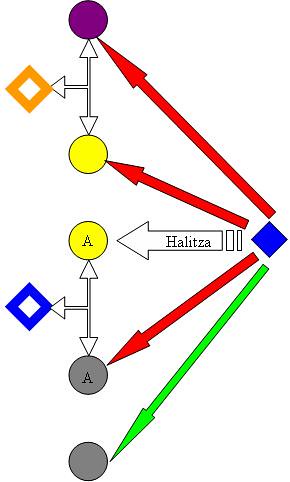
Click on the picture below to be able to actually read it:
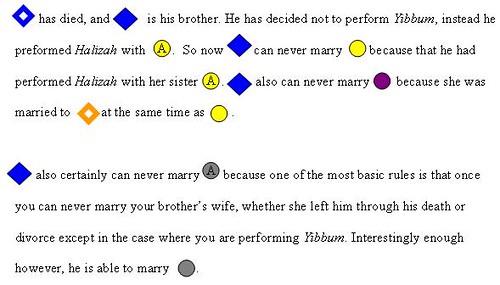
ד,ז החולץ ליבמתו--הוא אסור בקרובותיה, והיא אסורה בקרוביו. הוא אסור באימה, ובאם אימה, ובאם אביה, בבתה, ובבת בתה, ובבת בנה, ובאחותה בזמן שהיא קיימת; והאחים מותרים. והיא אסורה באביו, ובאבי אביו, בבנו, ובבן בנו, באחיו, ובבן אחיו. מותר אדם בקרובת צרת חלוצתו, ואסור בצרת קרובת חלוצתו.
This is just how complicated Yibbum and Halizah used to be when men had multiple wives.
An explanation of the diagram:
Diamonds are males. Circles are females.
Shapes with the same color are related, brothers or sisters.
Hollow shapes are dead, full ones are alive.
Click on the picture below to be able to actually read it:
Monday, March 12, 2007
Targum for Pequdei - Engraving in Hebrew and Aramaic
Shabbat, just a few hours ago for me we read Vayaqhel-Pequdei. I made a note to myself to blog about this for Tetzaveh, but I forgot about it, so luckily it completely repeats itself in Pequdei.
What I was interested in was the word גלופה which I became acquainted with when I trying to translate the order forms for the SAVE DARFUR / הצילו את דרפור shirts
which HAeD prints. In modern Hebrew גלפ means
גְּלוּפָה שֵם נ' (printing) block, plate
גִּלּוּף שֵם ז' carving, etching, engraving
What piqued my intrest in the root גלפ is that it for some reason sounded familiar in the context of printing. After a few days of it bothering me, I finally hit on it. גלפ or גלופה (g-l-pf or glufa) sounds exactly like glyph. Here is what glyph means according to Answers.com (Answers.com is actually an Israeli company, that much I knew. But who knew they are right next to the mall in Jerusalem!)
They may be right that glyph reached English though French, Greek and Latin, but I will tkae it a step back and say that it comes from the Aramaic גלפ
Here is where the word appears in the Targum to this weeks Parsha
שמות לט,ו
וַיַּעֲשׂוּ אֶת-אַבְנֵי הַשֹּׁהַם, מֻסַבֹּת מִשְׁבְּצֹת זָהָב, מְפֻתָּחֹת פִּתּוּחֵי חוֹתָם, עַל-שְׁמוֹת בְּנֵי יִשְׂרָאֵל
וַעֲבַדוּ יָת אַבְנֵי בֻּרְלָא, מְשַׁקְּעָן מְרַמְּצָן דִּדְהַב,גְּלִיפָן כְּתָב מְפָרַשׁ, עַל שְׁמָהָת בְּנֵי יִשְׂרָאֵל
שמות לט,יד
לט,יד וְהָאֲבָנִים עַל-שְׁמֹת בְּנֵי-יִשְׂרָאֵל הֵנָּה, שְׁתֵּים עֶשְׂרֵה--עַל-שְׁמֹתָם:פִּתּוּחֵי חֹתָם אִישׁ עַל-שְׁמוֹ, לִשְׁנֵים עָשָׂר שָׁבֶט
וְאַבְנַיָּא עַל שְׁמָהָת בְּנֵי יִשְׂרָאֵל אִנִּין, תַּרְתַּא עַסְרֵי--עַל שְׁמָהָתְהוֹן: כְּתָב מְפָרַשׁ כִּגְלָף דְּעִזְקָא גְּבַר עַל שְׁמֵיהּ, לִתְרֵי עֲסַר שִׁבְטִין.
Other instances of root גלפ in the targum
שמות כח9
שמות כח11
שמות כח21
שמות כח36
What I was interested in was the word גלופה which I became acquainted with when I trying to translate the order forms for the SAVE DARFUR / הצילו את דרפור shirts
which HAeD prints. In modern Hebrew גלפ means
גְּלוּפָה שֵם נ' (printing) block, plate
גִּלּוּף שֵם ז' carving, etching, engraving
What piqued my intrest in the root גלפ is that it for some reason sounded familiar in the context of printing. After a few days of it bothering me, I finally hit on it. גלפ or גלופה (g-l-pf or glufa) sounds exactly like glyph. Here is what glyph means according to Answers.com (Answers.com is actually an Israeli company, that much I knew. But who knew they are right next to the mall in Jerusalem!)
A symbolic figure that is usually engraved or incised or A displayed or printed image. In typography, a glyph may be a single letter, an accent mark or a ligature.They have some etymology too
They have some Hebrew translation, but every time I copied it to blogger, it would mess up the whole post reversing the English and messing all the HTML so if you want to see it, take a look its at the very end of the site.Etymology
The term has been used in English since 1727, loaned from glyphe in use by French antiquaries (since 1701), from Greek γλυφη "a carving," from γλύφειν "to hollow out, engrave, carve" (cognate to Latin glubere "to peel" and English cleave). - http://www.answers.com/glyph&r=67
They may be right that glyph reached English though French, Greek and Latin, but I will tkae it a step back and say that it comes from the Aramaic גלפ
Here is where the word appears in the Targum to this weeks Parsha
שמות לט,ו
וַיַּעֲשׂוּ אֶת-אַבְנֵי הַשֹּׁהַם, מֻסַבֹּת מִשְׁבְּצֹת זָהָב, מְפֻתָּחֹת פִּתּוּחֵי חוֹתָם, עַל-שְׁמוֹת בְּנֵי יִשְׂרָאֵל
וַעֲבַדוּ יָת אַבְנֵי בֻּרְלָא, מְשַׁקְּעָן מְרַמְּצָן דִּדְהַב,גְּלִיפָן כְּתָב מְפָרַשׁ, עַל שְׁמָהָת בְּנֵי יִשְׂרָאֵל
שמות לט,יד
לט,יד וְהָאֲבָנִים עַל-שְׁמֹת בְּנֵי-יִשְׂרָאֵל הֵנָּה, שְׁתֵּים עֶשְׂרֵה--עַל-שְׁמֹתָם:פִּתּוּחֵי חֹתָם אִישׁ עַל-שְׁמוֹ, לִשְׁנֵים עָשָׂר שָׁבֶט
וְאַבְנַיָּא עַל שְׁמָהָת בְּנֵי יִשְׂרָאֵל אִנִּין, תַּרְתַּא עַסְרֵי--עַל שְׁמָהָתְהוֹן: כְּתָב מְפָרַשׁ כִּגְלָף דְּעִזְקָא גְּבַר עַל שְׁמֵיהּ, לִתְרֵי עֲסַר שִׁבְטִין.
Other instances of root גלפ in the targum
שמות כח9
שמות כח11
שמות כח21
שמות כח36
A friend deals with the etymology of Ptil/פתיל with his knowledge of Russian http://kopo.livejournal.com/15941.html
Friday, March 9, 2007
Parshat Ki Tisa - Targum, play on words?
לב,לב וְעַתָּה, אִם-תִּשָּׂא חַטָּאתָם; וְאִם-אַיִן--מְחֵנִי נָא, מִסִּפְרְךָ אֲשֶׁר כָּתָבְתָּ.
Targum :
וּכְעַן, אִם שְׁבַקְתְּ לְחוֹבֵיהוֹן; וְאִם לָא--מְחֵינִי כְּעַן, מִסִּפְרָךְ דִּכְתַבְתָּא.
לב,לה וַיִּגֹּף יְהוָה, אֶת-הָעָם, עַל אֲשֶׁר עָשׂוּ אֶת-הָעֵגֶל, אֲשֶׁר עָשָׂה אַהֲרֹן.
Targum
וּמְחָא יְיָ, יָת עַמָּא, עַל דְּאִשְׁתַּעֲבַדוּ לְעִגְלָא, דַּעֲבַד אַהֲרוֹן.
Moshe asks Hashem to forigve the Jewish People after the sin of the golden calf, and if not he asks that hashem wipe out (Maha) his name from the Torah
Later when Hashem decides to forgive the Jewish people, yet also send a plauge against them, the Torah uses the word Nagaf (meaning strike). While in the Targum the word Maha is used. While it is true the the word Maha is used many times in the Targum as a translation of Nagaf, it doesn't 100% of the time.
Whether accidental or on purpose it is interesting to note that possible answer to Moshe's request that he me wiped out is met by Hashem partially wiping out some of Israel.
Where else do we see the Hebrew word Maha to refer to wiping out a nation?
- Amalek
Targum :
וּכְעַן, אִם שְׁבַקְתְּ לְחוֹבֵיהוֹן; וְאִם לָא--מְחֵינִי כְּעַן, מִסִּפְרָךְ דִּכְתַבְתָּא.
לב,לה וַיִּגֹּף יְהוָה, אֶת-הָעָם, עַל אֲשֶׁר עָשׂוּ אֶת-הָעֵגֶל, אֲשֶׁר עָשָׂה אַהֲרֹן.
Targum
וּמְחָא יְיָ, יָת עַמָּא, עַל דְּאִשְׁתַּעֲבַדוּ לְעִגְלָא, דַּעֲבַד אַהֲרוֹן.
Moshe asks Hashem to forigve the Jewish People after the sin of the golden calf, and if not he asks that hashem wipe out (Maha) his name from the Torah
Later when Hashem decides to forgive the Jewish people, yet also send a plauge against them, the Torah uses the word Nagaf (meaning strike). While in the Targum the word Maha is used. While it is true the the word Maha is used many times in the Targum as a translation of Nagaf, it doesn't 100% of the time.
Whether accidental or on purpose it is interesting to note that possible answer to Moshe's request that he me wiped out is met by Hashem partially wiping out some of Israel.
Where else do we see the Hebrew word Maha to refer to wiping out a nation?
- Amalek
Sunday, February 18, 2007
Religious Zionism vs Modern Orthodoxy
What is the difference between the way the way the Religious-Zionists(RZ) look at the secular and the way the Modern Orthodox(MO) look at the secular?
Torah U’Madda, Torah V’Avodah, what’s the difference?
Let’s make it very clear that neither is Torah U’parnasa, the ideology that masquerades as part of the MO world. It’s so clear that people need to make a living, and in the past people made a living. Haredim also work. Not being in denial about the fact that you need to provide for yourself and your family is not some new idea, and it’s not much of an ideology either.
The followers of Ha’Rav (Kook) talk about bringing the secular and the holy together to reach a combination that is elevated above either one.
The followers of The Rav (Soloveitchik) talk about the secular that has a real truth which can bring one closer to knowledge of G-d, in a similar way as Torah does.
Don’t read too much into that, its just what I hear from people who claim to be the students of The Rav or Ha’Rav.
I was writing this up after hearing a shiur about Purim in which Rav Kook was used as a source many ties in discussing how Purim was a special holiday that represents the eventual eschatological era when the greatest connection to G-d will be attained through physical and spiritual means with no conflict between the two. After the shiur I was reading some Kol Dodi Dofek. This question of MO vs RZ has been on my mind for ages. It was emphasized at a Tish by Rabbi Yosef Blau of
As I was writing this in the front of the beit midrash, Rav Cherlow was giving a shiur on Orot Ha’Rav Kook. I wasn’t in the shiur because the shiur I was just in ended long after Rav Cherlow’s began. However suddenly I hear him talking about Rav Soloveitchik, and the difference between him and Rav Kook. Apperntly someone asked a question about it. I only caught the end of Rav Cherlow’s response, which would be interesting because people say he represents
Well that was a short little look into the matter, with no sources or anything passing for a real analysis. Just a sort of an intro to the subject to the hang of blogging.
Another subject I am thinking about a lot is State of Israel vs
Subscribe to:
Posts (Atom)


